📈 Investment Calculator
Plan your investments and calculate your future wealth
This calculator provides an estimate based on the values you enter. Actual investment returns can vary and may be affected by fees, taxes, inflation, and market performance.
Investment Calculator – Calculate Your Future Investment Growth
Planning for your financial future can feel difficult when you do not know how much your money could grow over time. An Investment Calculator makes this process easier by showing an estimated future balance based on your starting amount, investment period, expected return rate, compound frequency, and additional contributions. Instead of calculating everything manually, you can enter a few numbers and quickly understand how compound growth may affect your investment. Our free Investment Calculator also breaks the results into starting money, total contributions, and estimated interest. Whether you are saving for retirement, a major purchase, education, or long-term financial goals, this tool can help you make more informed plans.
What Is an Investment Calculator?
An Investment Calculator is a financial planning tool that estimates how much an investment could be worth after a specific period. It uses information such as your initial investment, expected annual return, compounding frequency, and regular contributions. The calculator applies these values to estimate the potential growth of your money over time.
One of the most important concepts behind investment growth is compound interest. With compound growth, your investment can potentially earn returns on both the original amount and previously accumulated returns. Over longer periods, this effect can make a significant difference in the final balance.
Our calculator is designed to make these calculations simple. You do not need advanced financial or mathematical knowledge to use it. Simply enter your investment details, click the calculate button, and review the estimated results.
How to Use the Investment Calculator
Using the Investment Calculator is quick and straightforward. Follow these steps to estimate your potential investment growth.
1. Enter the Starting Amount
Start by entering the amount you plan to invest initially. This could be your current savings or the amount you want to invest today.
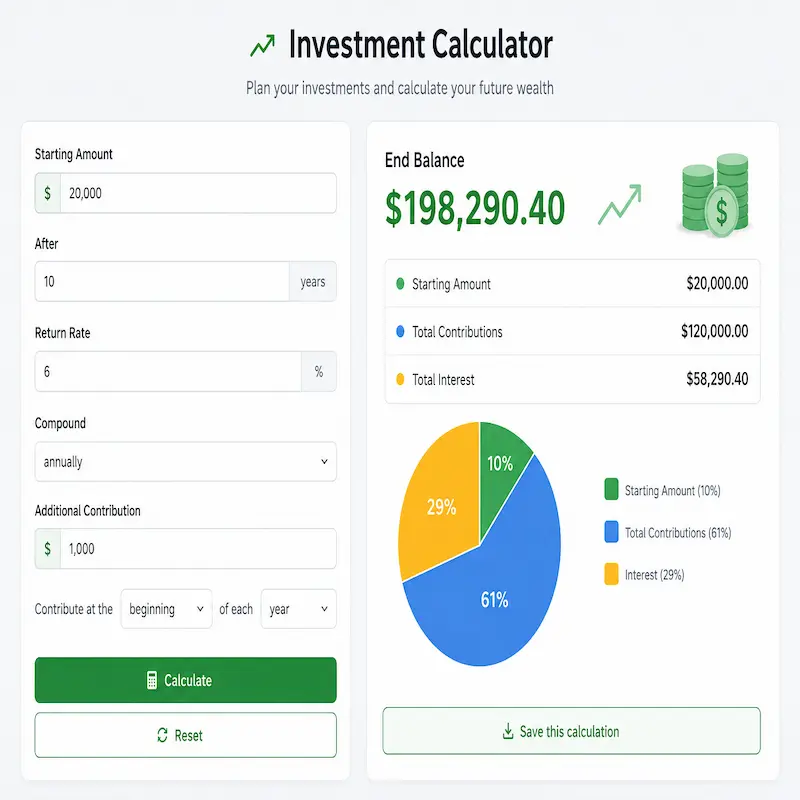
For example, if you have $20,000 available for investment, enter 20,000 in the Starting Amount field.
2. Select the Investment Period
Enter how long you expect to keep your money invested. You can enter the number of years for your investment plan.
A longer investment period can give compound growth more time to work. However, the actual outcome will depend on investment performance and other factors.
3. Enter the Expected Return Rate
The Return Rate represents the annual percentage return you expect from the investment.
For example, entering 6% means you are estimating an average annual return of 6%. This is only an assumption for the calculation and does not guarantee that an investment will actually produce that return.
4. Choose the Compounding Frequency
The calculator lets you select how often returns are compounded. Depending on the tool settings, you can choose options such as:
- Annually
- Semi-annually
- Quarterly
- Monthly
- Daily
Compounding frequency can affect the estimated result because returns may be added to the investment at different intervals.
5. Add Regular Contributions
If you plan to invest additional money regularly, enter the contribution amount in the Additional Contribution field.
For example, you might start with $20,000 and add $1,000 every month or year. Regular contributions can substantially increase the total amount invested over a long period.
6. Select Contribution Timing
You can also specify whether your additional contribution is made at the beginning or end of each selected period.
This can affect the calculation because money contributed earlier has more time to potentially earn returns.
7. Click Calculate
After entering your information, click Calculate. The tool will immediately estimate your future investment balance and display a breakdown of the results.
Understanding Your Investment Calculator Results
The calculator provides several important figures that can help you understand your investment plan.
End Balance
The End Balance represents the estimated value of your investment at the end of the selected period.
This amount includes your starting investment, additional contributions, and estimated investment growth.
For example, if your calculation shows an end balance of $198,290.40, this represents the estimated total value based on the numbers entered into the calculator.
Starting Amount
The Starting Amount shows the money you initially invested.
This is separated from your regular contributions and estimated interest so you can clearly understand where the final balance comes from.
Total Contributions
Total Contributions represent the additional money you added throughout the investment period.
Regular contributions can have a powerful effect on long-term investment growth because they increase the amount of capital working toward your financial goal.
Total Interest
Total Interest represents the estimated growth generated by the investment calculation after accounting for the starting amount and additional contributions.
A higher return rate or longer investment period can increase the potential interest amount, although actual investment returns are never guaranteed.
Why Compound Growth Matters
Compound growth is one of the most important ideas in long-term investing. Instead of earning returns only on your original investment, future returns can also build upon previously accumulated growth.
Consider a simple example. If you invest $10,000 and earn an average return, the investment may grow over time. As the balance increases, future returns are calculated on a larger amount.
This is why starting early can be valuable for long-term investors. Even relatively small regular contributions may become significant when they are maintained over many years.
However, compound growth works in both directions. Investment values can also decline when markets perform poorly, so calculator results should always be treated as estimates rather than guarantees.
Benefits of Using an Investment Calculator
Easy Financial Planning
The calculator allows you to test different investment scenarios quickly. You can change the investment amount, return rate, duration, and contributions to see how the estimated outcome changes.
Understand Long-Term Growth
Seeing projected numbers can make it easier to understand how time and compound growth may influence your finances.
Compare Different Strategies
You can run multiple calculations to compare different contribution amounts or investment periods. This can help you understand the potential impact of increasing your regular investment.
Save Time
Manual investment calculations can be complicated, especially when regular contributions and different compounding frequencies are involved. An online calculator handles the mathematical calculations for you.
Set Realistic Goals
By experimenting with different scenarios, you can create more realistic financial targets and determine how much you may need to contribute toward a long-term goal.
Example Investment Calculation
Suppose you start with $20,000 and plan to invest for 10 years. You expect an average annual return of 6% and make regular additional contributions.
You can enter these figures into the Investment Calculator and select your preferred compounding and contribution frequency. The calculator will then estimate the future balance and separate the result into your starting amount, contributions, and estimated investment growth.
This example demonstrates why it is useful to experiment with different scenarios. Increasing your contribution, changing the investment period, or adjusting the assumed return rate can produce very different projected outcomes.
Investment Calculator for Long-Term Planning
An Investment Calculator can be useful for many financial goals. You can use it to explore potential savings for retirement, education, a home purchase, emergency reserves, or other long-term objectives.
For retirement planning, for example, you can estimate how regular contributions might affect your potential future balance. Someone starting earlier may have more time to benefit from compound growth, while someone starting later may need larger contributions to reach a similar target.
The calculator can also help you understand the relationship between time, contributions, and potential returns.
Tips for Better Investment Planning
Use realistic return assumptions rather than choosing an unusually high rate simply to produce a larger projected balance. Consider investing consistently because regular contributions can make a meaningful difference over time. Review your financial goals periodically and adjust your contribution strategy when your circumstances change.
It is also important to remember that investments involve risk. Market performance can fluctuate, and actual returns may be higher or lower than the assumptions used in a calculator. Fees, taxes, inflation, and other costs can also affect your real-world results.
Frequently Asked Questions
What is an Investment Calculator used for?
An Investment Calculator is used to estimate the potential future value of an investment based on factors such as starting money, return rate, investment duration, compounding, and additional contributions.
Is the Investment Calculator free?
Yes. The calculator can be used to estimate investment growth without manually performing complicated calculations.
Does the calculator guarantee my investment return?
No. Calculator results are estimates based on the assumptions you enter. Actual investment performance can vary because markets and investment returns are unpredictable.
Does adding regular contributions make a difference?
Yes. Regular contributions increase the total amount invested and can potentially increase the final balance, particularly when contributions are made consistently over a long period.
What does compound interest mean?
Compound interest means that investment growth can be added to your balance, allowing future growth to potentially occur on both your original investment and previous growth.
Can I change the return rate?
Yes. You can enter different expected return rates to compare various investment scenarios. Keep in mind that a higher assumed return also generally represents greater uncertainty or risk depending on the investment.
Final Thoughts
Our Investment Calculator provides a simple way to explore how your money could potentially grow over time. By entering your starting amount, investment period, expected return rate, compounding frequency, and regular contributions, you can quickly estimate a future balance. The results also show your total contributions and estimated interest, making it easier to understand the different components of your projected wealth. Use the tool to compare different scenarios and create a clearer picture of your long-term financial goals. Remember that all calculations are estimates, and actual investment returns can differ because of market conditions, fees, taxes, inflation, and other factors.